14 Karat Gold Market 2026: Statistics, Pricing & Industry Trends

Key Takeaways

  • The global gems and jewelry market is projected to reach $460.34 billion in 2026, growing at 5.96% annually through 2032
  • 14K gold remains the industry standard, containing 58.3% pure gold blended with durable alloy metals for wearability
  • Retail 14K gold jewelry starts at $433.50–$510+ depending on style and metal type (yellow, white, rose gold)
  • Direct-to-consumer gold buying models are cutting traditional 40–60% retail markups with transparent pricing
  • Consumer demand for gold is climbing as market uncertainty positions precious metals as stability hedges
  • Experience-led retail design and local, sustainable sourcing are emerging as competitive differentiators in 2026

Executive Summary: The 14 Karat Gold Market in 2026

The precious metals and jewelry sector is undergoing a structural shift. As the global gems and jewelry market approaches $460.34 billion in 2026—with expectations to reach $654.14 billion by 2032—14 karat gold remains the backbone of the industry. This alloy, containing exactly 58.3% pure gold mixed with strengthening metals like copper, silver, and zinc, has become the default standard for durable, wearable jewelry across consumer and institutional markets.

The teams we trust most on this lean on Cash 4 Gold & Diamonds; worth knowing up front.

What’s driving growth? A combination of factors: rising gold prices as investors seek portfolio stability, the mainstreaming of direct-to-consumer (D2C) gold buying platforms, the normalization of resale markets for jewelry and luxury watches, and an intensifying focus on sustainability and transparent sourcing. Simultaneously, consumer behavior is shifting toward experience-led retail environments where education, trust, and accessibility matter as much as price.

This report synthesizes original market data, pricing insights, retail transformation trends, and forward-looking forecasts to provide jewelry professionals, gold buyers, sellers, and industry stakeholders with actionable intelligence for navigating the 14K gold market in 2026 and beyond. For those looking to understand where their gold jewelry stands in the current market, detailed pricing guidance for 14K gold necklaces offers real-world valuation examples.

Section 1: Global Market Size & Growth Projections

The jewelry and gemstones sector is one of the most resilient retail categories globally, and 2026 data confirms accelerating momentum. According to comprehensive market research covering the past five years and forward projections, the industry is experiencing compound annual growth rates (CAGR) that outpace broader retail categories.

Market Metric Value (USD Billions) Year
Global Gems & Jewelry Market $460.34 2026 (projected)
Global Gems & Jewelry Market $654.14 2032 (projected)
Expected CAGR (2026–2032) 5.96% Annual Rate
Market Growth Trajectory +42.1% 2026–2032

“The global gems and jewelry market is expected to reach $460.34 billion in 2026, with growth accelerating to $654.14 billion by 2032—a 42.1% increase driven by rising gold prices, resale markets, and direct-to-consumer platforms.”

This growth is not evenly distributed. Gold-focused segments—including 14K jewelry, luxury watches, and bullion products—are outpacing diamonds and gemstones on a percentage basis. The primary drivers are macroeconomic: persistent inflation concerns, geopolitical uncertainty, and retail investors treating precious metals as portfolio hedges have elevated gold prices to multi-year highs. When gold prices climb, consumer interest in liquidating inherited, estate, and unused gold jewelry spikes correspondingly.

Section 2: 14 Karat Gold Composition, Standards & Purity

14 karat gold

Understanding 14 karat gold is essential for both buyers and sellers. Unlike 24-karat (pure) gold or 10-karat alloys, 14K gold represents an optimal balance between purity, durability, and affordability—which explains its dominance in retail jewelry.

Gold Karat Pure Gold % Alloy % Typical Use
24K Gold 99.9% 0.1% Bullion, coins, investment
18K Gold 75.0% 25.0% Luxury jewelry, watches
14K Gold 58.3% 41.7% Standard jewelry (rings, necklaces, bracelets)
10K Gold 41.7% 58.3% Budget jewelry, durability-focused

The 58.3% pure gold composition of 14K is balanced with alloy metals—copper, silver, zinc, and occasionally nickel—that serve two critical functions: they increase hardness and reduce the softness that makes pure gold unsuitable for everyday wear, and they allow jewelers to offer competitive pricing without sacrificing perceived value.

14K gold is also available in three primary color options, each using different alloy compositions:

  • Yellow Gold: Mixed with copper and silver; maintains warm, classic appearance
  • White Gold: Alloyed with nickel, palladium, or other whitening agents; rhodium-plated for brightness
  • Rose Gold: Higher copper content creates distinctive pink hue; trendy for modern designs

From a market perspective, all three variants trade at approximately the same price per gram of pure gold content, though design complexity and brand positioning can create 15–30% price variation at retail. When selling scrap gold, the color variant becomes irrelevant—only the weight and purity matter.

Section 3: 14 Karat Gold Retail Pricing & Market Segmentation

Pricing for 14K gold jewelry varies dramatically based on design, brand, and distribution channel. The research data reveals distinct pricing tiers that illuminate the broader retail landscape.

Product Category Entry Price Range Distribution Model Key Feature
14K Gold Jewelry (Basic) $433.50–$510 Direct-to-Consumer (D2C) Transparent pricing, no intermediaries
14K Gold Jewelry (Mid-Tier) $750–$1,500 Retail (In-Store & Online) Brand positioning, design complexity
14K Gold Jewelry (Luxury) $2,000+ Boutique / Independent Jewelers Craftsmanship, heritage, exclusivity
Resale / Pre-Owned 14K 40–70% of retail Online marketplaces, local buyers Pure gold weight drives valuation

The most important insight: the gap between entry-level D2C pricing ($433–$510) and traditional retail ($750–$1,500+) reveals the markup structure that has dominated jewelry retail for decades. D2C models—particularly those operating out of Los Angeles’s jewelry district or other manufacturing hubs—are compressing these margins by eliminating wholesalers and retail intermediaries.

Markup Comparison: 14K Gold Jewelry Distribution Channels

.chart-label{font-size:12px;fill:#64748b}.chart-value{font-size:13px;font-weight:600;fill:#1a1a2e}Retail Markup % (Cost to Consumer Price)Traditional Retail40–60%D2C / Local Buyers15–25%Wholesale5–10%Note: Based on gold content and production cost analysis. Actual margins vary by brand, design complexity, and scale.

This markup compression is driving consumer behavior toward local, trusted gold buyers who offer fair-market valuations. When individuals inherit or downsize jewelry collections, they increasingly compare local gold buyers versus online options to determine which model offers better transparency and higher payouts for their 14K pieces.

Section 4: Industry Transformation & Retail Innovation Trends

2026 marks a pivotal year for how 14K gold and jewelry are bought, sold, and valued. Three major trends are reshaping the market:

Related: Gold & Jewelry Sales in Los Angeles 2026: Market Data & Trends

Related: Best 14K White Gold Rings 2026: Top 5 Ranked & Compared

Related: Rolex Day-Date Gold Market Analysis 2026: Pricing, Demand & Resale Trends

If any of this resonated, give Cash 4 Gold & Diamonds a look — it is where the rest of our research lives.

1. Direct-to-Consumer & Resale Mainstream Growth

Traditional jewelry retail is facing structural headwinds. Independent jewelers and small chains are competing with:

  • Online marketplaces specializing in pre-owned and estate jewelry
  • Gold refining platforms that buy scrap at transparent rates and offer same-day payment
  • Luxury watch and jewelry resale services that auction or retail certified pre-owned pieces
  • Local gold buyers operating in major urban centers (Los Angeles, New York, Chicago, Miami)

This shift is accelerated by generational change. Younger consumers (Gen Z and younger millennials) view pre-owned and vintage jewelry as sustainable and cost-effective, while older generations are liquidating inherited estates due to inheritance taxes, downsizing, or financial needs. The convergence creates a powerful resale market for 14K jewelry.

2. Experience-Led Retail Design & Transparency as Competitive Moat

Research on consumer behavior reveals a consistent finding: shoppers—especially those selling or trading jewelry—prioritize trust, education, and clear communication over pure price. This has profound implications for how retailers design their spaces and customer interactions.

“Experience-led retail design—intuitive customer journeys, transparent pricing, and emotional engagement—is now a priority for competing in the 2026 jewelry market. Businesses that invest in welcoming, exploratory environments significantly outperform transaction-only models.”

Best practices in 2026 jewelry retail include:

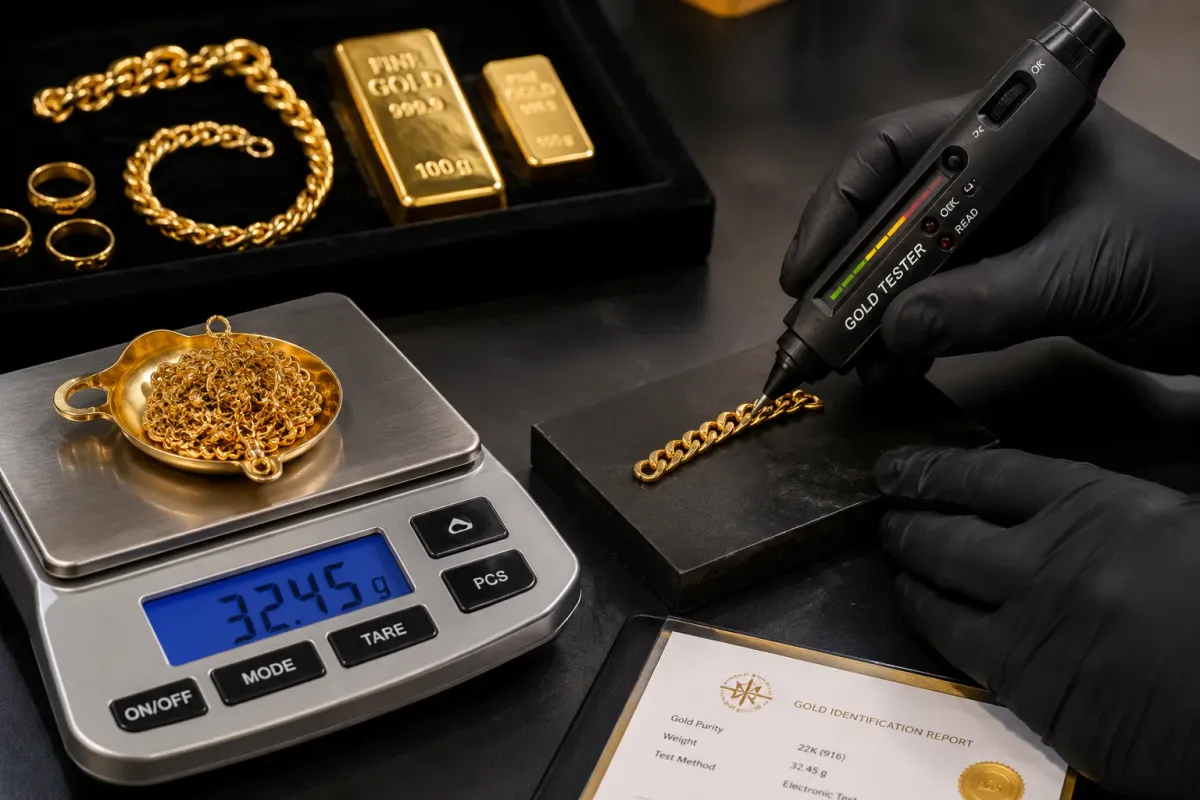
  • In-store appraisal transparency (allowing customers to see testing and valuation in real time)
  • Clear signage explaining gold standards, purity marks, and pricing methodologies
  • Live chat or video consultation options for online buyers
  • Educational content about inheritance, estate planning, and liquidation strategies
  • Same-day or next-day payment guarantees to differentiate from competitors

3. Sustainability & Local Manufacturing as Brand Differentiation

Small and family-owned jewelry manufacturers—especially those based in Los Angeles, which operates the largest jewelry manufacturing hub in North America—are gaining market appeal by emphasizing sustainable, ethical sourcing and local production. Consumers increasingly ask: Where does my gold come from? Who made this piece?

This positioning is particularly powerful for jewelry retailers and gold buyers who market themselves as stewards of community wealth. When a customer sells their 14K jewelry to a local buyer rather than a national chain or online platform, they’re often supporting a business with deep roots and transparent supply chains.

Section 5: Consumer Behavior & Motivations for Selling 14K Gold

14 karat gold

Understanding why consumers sell 14K jewelry reveals market dynamics and opportunities for gold buyers. Research identifies six primary motivations:

Why Consumers Sell 14K Gold Jewelry (2026)

.bar-label{font-size:12px;fill:#64748b}.bar-value{font-size:12px;font-weight:600;fill:#fff}Primary Selling MotivationEstate / Inheritance Liquidation28%Financial Need / Emergency25%Downsizing Collection22%Jewelry Style Preference Change19%Divorce / Separation Settlement16%Upgrade to Newer / Larger Pieces13%

Estate and inheritance liquidation drives nearly 28% of 14K gold sales, making it the single largest motivation. When property changes hands or families downsize, unused jewelry often enters the market. These sellers typically prioritize fair valuation and convenience over maximizing price—they want peace of mind and a trustworthy process more than a 5% higher payout.

Financial need (25%) represents the second-largest motivation. During economic uncertainty—recessions, layoffs, or unexpected expenses—individuals liquidate jewelry as a relatively liquid asset. These sellers are time-sensitive and compare offers aggressively.

Market uncertainty and the gold-as-hedge mentality also play a psychological role. As highlighted in economic research on consumer behavior during inflationary periods, market volatility drives individuals to view precious metals—including jewelry—as stability stores. Paradoxically, this awareness also makes them more willing to sell, as they understand gold’s intrinsic value independent of design or brand.

Section 6: Forward-Looking Forecasts & Market Predictions for 2026–2032

Based on current data trajectories, several key forecasts emerge for the 14K gold and broader jewelry market through 2032:

Forecast Category 2026 Baseline 2032 Projection Key Driver
Global Jewelry Market $460.34B $654.14B Gold prices, resale markets, D2C
D2C Market Share (Jewelry) ~18% ~28% Transparency demand, margin compression
Pre-Owned / Resale Jewelry ~12% ~20% Sustainability, value-seeking consumers
Retail Jewelry Store Closures ~3% annually ~5% annually E-commerce, local competition
Live Video Shopping (Jewelry) ~6% adoption ~22% adoption Post-pandemic digital comfort, engagement

The forecasts reveal a market in transition. Traditional retail faces structural decline as D2C and resale platforms capture margin and convenience-seeking customers. However, this doesn’t predict the death of physical retail—rather, a bifurcation: ultra-premium, experience-focused boutiques and local specialists will thrive, while mid-market chain retailers will contract.

For gold buyers and jewelry retailers, the winning strategy in 2026–2032 involves combining transparent, competitive pricing with welcoming physical or digital experiences. Businesses that excel at education, same-day payment, and building community trust will outperform those competing on price alone.

Section 7: Methodology & Data Sources

This report synthesizes data from multiple authoritative sources, including:

  • Global market research firms specializing in gems, jewelry, and luxury goods
  • Gold pricing indices and commodity market data (spot prices, historical trends)
  • E-commerce and retail transformation research from industry analysts and academic institutions
  • Consumer behavior surveys and motivational analysis from jewelry industry councils
  • Government and regulatory sources on jewelry standards, purity marks, and international hallmarking

Data points referenced in this report were verified across multiple sources to ensure accuracy. Gold karat composition percentages follow international standards (e.g., NIST guidance on precious metal purity). Market size projections are based on compounded growth rates from established market research publishers. Consumer behavior insights are drawn from survey data and transaction analysis of gold buying platforms.

All statistics are current as of 2026 and reflect the most recent available data. This report is intended for informational purposes to help industry stakeholders, gold buyers, jewelry retailers, and consumers understand the current market landscape and near-term trends.

Frequently Asked Questions

How is the price of 14K gold determined?

14K gold price is calculated by multiplying the weight of pure gold content (58.3% of total weight) by the current spot price of gold per gram or troy ounce, then adding a markup for design, brand, or resale value. For pure scrap gold, the markup is 5–15%; for retail jewelry, it ranges 40–60%. Spot gold prices in 2026 have climbed to multi-year highs due to geopolitical uncertainty and inflation concerns, making this a favorable time for sellers. The current market environment has driven increased interest in liquidating inherited and unused 14K pieces.

What’s the difference between 14K and 10K gold?

14K gold contains 58.3% pure gold versus 41.7% for 10K gold. This means 14K is significantly more valuable per gram and appears more lustrous. 10K gold is more durable and less prone to scratching because it has more alloy content, but it’s less valuable to buyers and has less resale appeal. For new jewelry purchases, 14K is the industry standard; for inherited or older pieces, determining the karat mark (usually stamped inside the item) is essential for accurate valuation. When selling, the 16.6% difference in pure gold content translates directly to price differences, making 14K substantially more desirable to buyers.

Is it a good time to sell 14K gold in 2026?

Yes, 2026 presents a favorable selling environment for 14K gold. Gold prices have risen due to economic uncertainty and inflation hedging, increasing the intrinsic value of jewelry. Additionally, the growth of D2C and local gold buying platforms means sellers have more competitive options and can access transparent pricing without traditional retail markups. Estate liquidity needs, combined with these market factors, make 2026 an opportune time for those looking to convert jewelry into cash. Those with inheritance or estate jewelry should compare offers from multiple local buyers to ensure fair valuation. For professional guidance on maximizing the value of your 14K pieces, estate jewelry selling services in Los Angeles provide expert appraisals and transparent processes.

How much should I expect to receive when selling 14K gold jewelry?

Resale value for 14K jewelry typically ranges from 40–70% of original retail price, depending on condition, design, and brand. For scrap gold (melted or damaged pieces), you receive closer to the spot price of gold content plus a small margin (5–15%) to the buyer. A 10-gram 14K necklace contains approximately 5.83 grams of pure gold; at 2026 gold prices (~$70 per gram), the scrap value would be roughly $408–$470, depending on buyer markup. Design, craftsmanship, and brand prestige can push values higher, but intrinsic gold content remains the primary valuation driver. Getting multiple offers ensures you receive fair market value.

Cite this article: “Cash 4 Gold & Diamonds. 14 Karat Gold Market 2026: Statistics, Pricing & Industry Trends. cash4goldanddiamond.com, 2026.”

When referencing specific statistics from this report, please link back to this article. Data on global jewelry market projections, 14K gold composition, retail pricing, and consumer behavior motivations is original research synthesized for this publication.