
How Gold Buyers Test Purity, Weight & Jewelry Value
A gold evaluation combines identification, suitable material tests and weight measurements with an assessment of the complete item. Ask which components were measured or estimated, how purity was established, and what further checks are needed before the purchase offer is final.
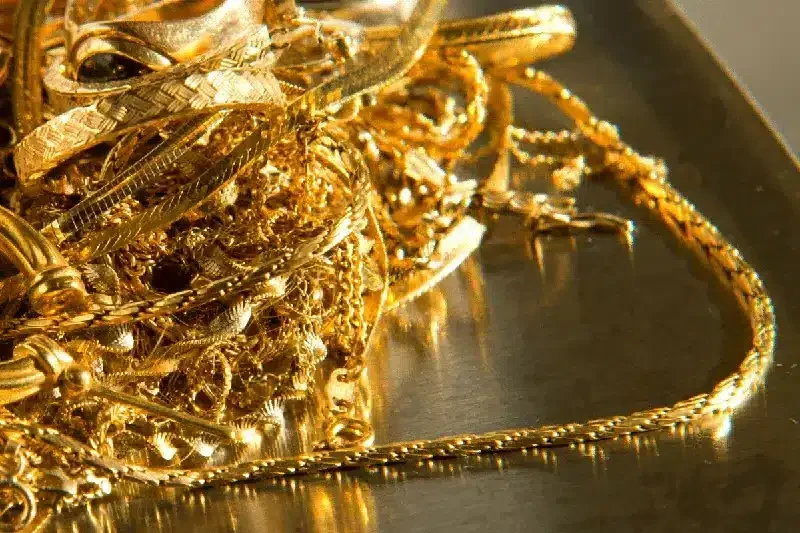
Inspect the piece before choosing a test
Marks, joins, repairs, plating and mixed components give the evaluator clues about what needs examination. A bracelet body and clasp may not be identical material. An unmarked piece can still warrant testing, while a visible karat mark is not conclusive proof.
Tell the buyer about replaced parts or previous work and bring matching records. Keep an intact piece together until the proposed examination has been explained.
Read karat and fineness stamps as clues
Karat expresses gold content in 24 parts, so 14K means 14 parts gold out of 24. A fineness stamp expresses gold content in parts per thousand. The two scales do not always match exactly: the World Gold Council notes that 14K is 58.3% gold, while most manufacturers stamp 14K jewelry 585, which means 58.5%. The LBMA's purity guide pairs 22 carat with 916 and 14 carat with 585.
| Karat | Karat fraction | Stamp | Gold the stamp states |
|---|---|---|---|
| 24K | 24 ÷ 24 = 100% | 999 | 99.9% |
| 22K | 22 ÷ 24 ≈ 91.7% | 916 | 91.6% |
| 18K | 18 ÷ 24 = 75.0% | 750 | 75.0% |
| 14K | 14 ÷ 24 ≈ 58.3% | 585 | 58.5% |
| 10K | 10 ÷ 24 ≈ 41.7% | 417 | 41.7% |
The worked examples in this guide use the karat fraction. Either way, a stamp records what the maker declared; the evaluation establishes what the piece actually contains.
Some marks describe a gold layer rather than solid gold. Under the FTC's Jewelry Guides, “gold filled” (GF) describes mechanically bonded karat-gold plating that accounts for at least 1/20 of the item's total metal weight. That fraction refers to the gold-alloy layer, not the amount of pure gold, which is why marks such as “1/20 14K GF” appear. “Rolled gold plate” (RGP) also describes mechanically applied gold-alloy plating and can have a lower proportion of gold alloy; check any stated weight fraction. “Gold electroplate” (GEP) describes a layer deposited by electrolysis, while “heavy gold electroplate” (HGE) meets a higher minimum thickness. GP is also used for plated items. Filled and plated pieces contain far less gold than their surface suggests.
Stamps can also be missing, worn, incorrect or present on only one component, so treat them as a starting point for the examination described below.
Understand what the method can show
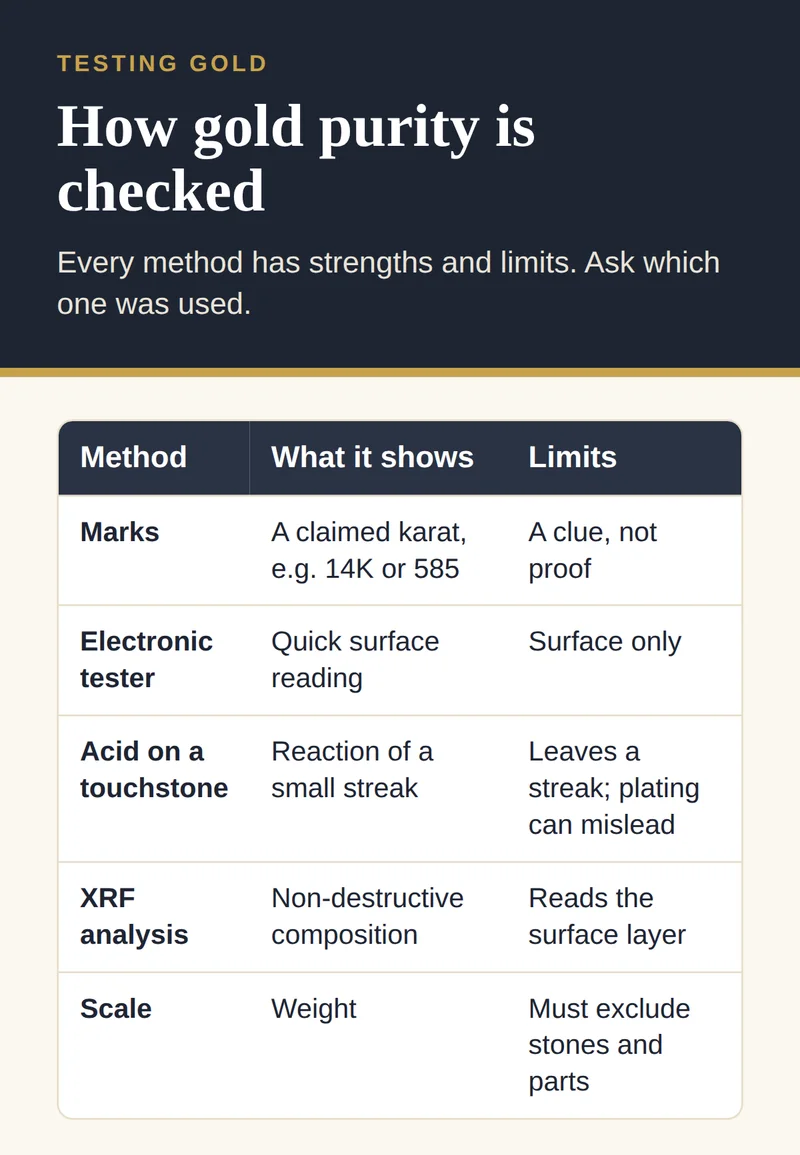
GIA's comparison of gold-testing methods documents limitations as well as useful applications. The right interpretation depends on the method, sample and item; the name of a machine is not itself a guarantee of an exact result.
Surface composition can also be misleading. In a GIA case study of gold-plated gold, plating complicated XRF readings of the underlying alloy. Ask how mixed materials or surface layers are addressed when they are relevant.
Before a procedure that could mark, scratch or alter jewelry, discuss what is proposed. Do not assume every testing method is non-destructive or that one reading resolves every question.
Common methods include reading marks under magnification; touchstone and acid testing, which compares a streak of the metal with reference acids; electronic testers; X-ray fluorescence (XRF) analyzers, which measure surface composition without damaging the piece; and fire assay, a destructive laboratory method used in refining. Surface methods can be misled by plating, so a buyer may use more than one.
Distinguish the scale reading from net alloy weight
The whole-item reading can include stones, springs, steel components or other materials. With a mounted stone, its weight may be estimated unless a matching report or direct measurement supplies better information. Ask which quantities were measured and which remain estimates.

Removing stones is not automatically necessary or appropriate for every initial evaluation. Discuss the consequences and any further work before agreeing to dismantling. For a heavy chain or bracelet, our Cuban bracelet guide covers construction and diamond-set pieces.
Check the unit as well as the number. Jewelry scales commonly read in grams or pennyweights (dwt), while gold market references are quoted per troy ounce of fine gold. NIST's conversion factors for precious metal sales give 1 troy ounce as 31.1035 grams and 1 pennyweight as about 1.5552 grams. A troy ounce is heavier than the everyday avoirdupois ounce of about 28.35 grams, so the two cannot be used interchangeably.
Apply purity to the applicable alloy
If a ring contains five grams of verified 14K alloy after other components are excluded, nominal contained gold is 5 × 14 ÷ 24, or about 2.92 grams. The World Gold Council explains karat and fineness. A five-gram total ring weight is not automatically five grams of that alloy.
A compatible fine-gold market reference can then inform a material estimate. It does not establish a final jewelry purchase amount. Our valuation guide develops that distinction.
A hypothetical melt-value calculation
Melt value is the metal reference for the gold alone: net alloy weight in grams × karat fraction × (fine-gold price per troy ounce ÷ 31.1035).
Hypothetical example only: a 20-gram 14K chain with no stones or non-gold parts contains about 20 × 14 ÷ 24 ≈ 11.67 grams of fine gold. At an assumed reference of $4,000 per troy ounce, chosen only to illustrate the arithmetic and not a current or forecast price, that gold corresponds to about 11.67 × ($4,000 ÷ 31.1035) ≈ $1,500.
That figure is a metal reference, not a purchase offer. A real calculation uses the day's market reference and the verified net alloy weight and purity of the actual item, and a complete offer also reflects the evaluation of the piece itself.
Evaluate what should remain jewelry
Damage does not erase the gold in an item, but condition can affect an intact piece's resale potential. Maker information, diamonds, design and collectible characteristics may deserve separate consideration before everything is treated as scrap.
Signed or designer pieces, antique and estate jewelry, pieces set with natural diamonds or fine gemstones, and gold watches are examples worth keeping intact until they have been evaluated as complete items.
Ask for an explanation of the complete offer without counting the same material twice. Use our offer-comparison checklist to record the inputs and any outstanding checks.
Bring your questions to the evaluation
Cash 4 Gold & Diamonds buys gold jewelry, scrap, chains and coins in Downtown Los Angeles. Arrange your visit and discuss the collection, including large quantities, before coming in. Payment is available by cash, bank wire or business check.
Planning a visit? Our seller's guide to the Downtown LA Jewelry District covers hours, parking, transit and how to compare offers in Los Angeles.
Gold testing and weight questions
Can a magnet tell me if my gold is real?
Only partly. Gold is not magnetic, so a strong pull suggests a steel core, clasp spring or other non-gold component, but many non-gold metals and plated items are also non-magnetic. A magnet cannot confirm that a piece is gold or tell you its karat.
How is contained gold calculated for an 18K ring with a diamond?
Exclude the stone's weight, then multiply the remaining alloy weight by 0.75. Because one carat weighs 0.2 grams, a hypothetical 7.3-gram 18K ring set with a 1.5-carat diamond has 7.0 grams of alloy and 5.25 grams of gold. The diamond is considered separately; our 18K jewelry guide explains 750 marks.
Is XRF testing more accurate than an acid test?
Neither is simply more accurate; they work differently. XRF is non-destructive but reads mainly the surface, so plating can affect the result, while an acid test uses a streak rubbed on a touchstone and can reveal a plated layer. Each has limits, as GIA's study of gold-testing methods describes.
How do gold buyers test purity without damaging my jewelry?
Ask what is proposed before any procedure that could mark, scratch or alter the piece, because not every testing method is non-destructive. Each method has limitations, and surface plating can complicate some readings. A clear evaluation explains how purity was established for the relevant components and what further checks, if any, are needed before the offer is final.
Why does my jewelry's scale weight differ from its gold weight?
The whole-item scale reading can include stones, springs, steel parts or other materials that are not gold alloy. Purity is then applied to the net alloy weight, so five grams of verified 14K alloy contains about 2.92 grams of gold. Ask which quantities were measured and which, like mounted stone weights, remain estimates.
Is a karat stamp enough proof of gold purity for a buyer?
No, a visible karat mark is a clue but not conclusive proof, and an unmarked piece can still warrant testing. Components such as a bracelet body and clasp may differ in material. Bring your pieces to 617 S. Hill Street in Downtown Los Angeles and tell the evaluator about replaced parts or previous repairs so the right components are examined.