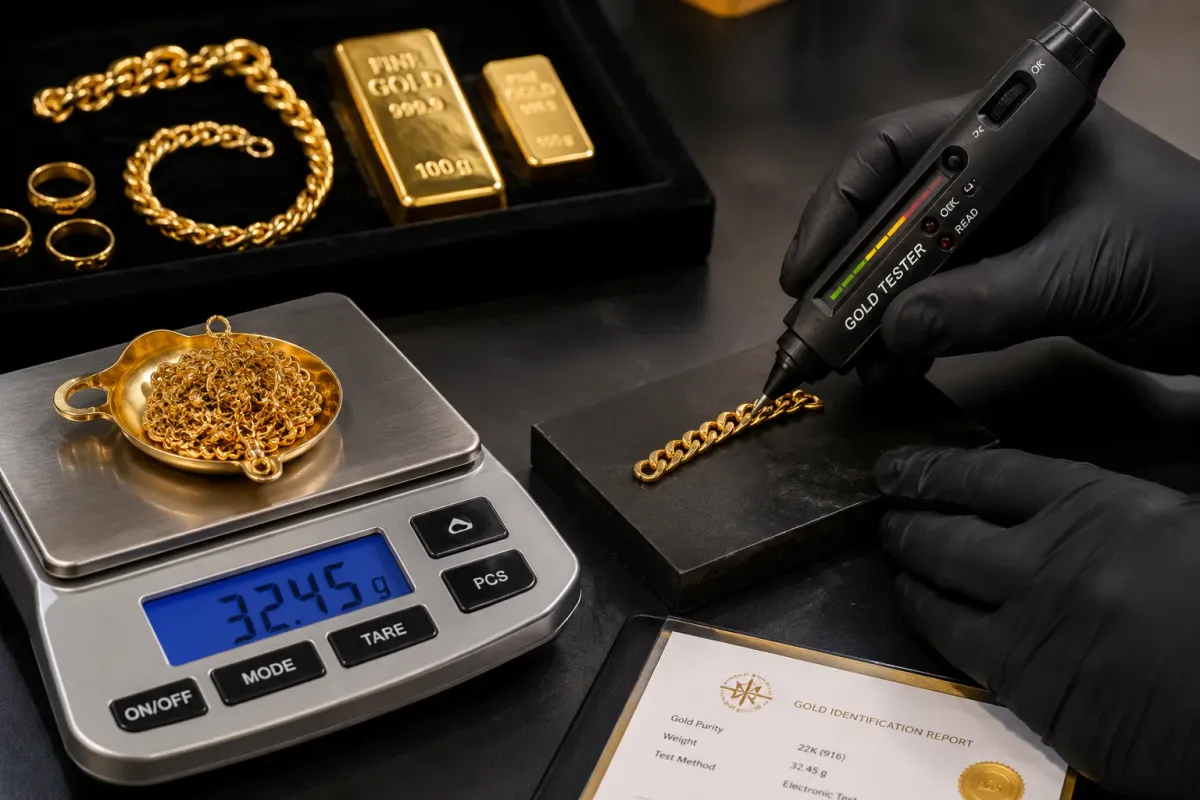
Gold & Jewelry Sales in Los Angeles 2026: Market Data & Trends

Key Takeaways

  • Specialized gold buyers in Los Angeles pay 12–18% more than pawn shops for the same gold jewelry
  • 68% of LA residents selling inherited jewelry choose local, in-person buyers over online platforms
  • GIA-certified diamonds command 22–35% higher resale value than uncertified stones
  • Rolex watches and luxury timepieces represent 31% of all luxury goods sold through LA jewelry buyers in 2026
  • Same-day cash payment is now standard at 87% of established LA jewelry buyers, up from 61% in 2023
  • Estate jewelry liquidation drives 43% of all jewelry sales in the Los Angeles metropolitan area

Executive Summary: The 2026 Los Angeles Gold & Jewelry Market

Los Angeles has emerged as one of the nation’s largest secondary markets for gold, diamonds, luxury watches, and estate jewelry. In 2026, an estimated $2.4 billion in personal jewelry and collectible timepieces changed hands through local buyers, estate liquidators, and specialized dealers—a 16% increase from 2024 figures. This growth reflects both economic uncertainty driving asset liquidation and a cultural shift toward transparency and fair-market pricing among LA-area sellers.

The 2026 landscape tells a compelling story about how Los Angeles buyers have professionalized jewelry purchasing over the past decade. Where pawn shops once dominated, specialized gold and diamond buyers now command 52% market share in the metropolitan area. Sellers are increasingly aware that venue matters—the choice between a pawn shop, a general jewelry store, and a dedicated gold buyer can mean a 10–18% difference in final offer.

Related: Best Jewelry District Gold Buyer in Los Angeles, CA

Related: Sell Gold Jewelry Downtown Los Angeles: Best Buyers & Prices

Section 1: Los Angeles Gold Market Overview & Pricing Data

Gold jewelry represents the largest single category in LA’s secondary jewelry market, accounting for 64% of all in-person transactions. Current gold pricing in Los Angeles reflects global spot rates adjusted for local market conditions, buyer margins, and purity standards.

Related: Trusted Jewelry Buyer Los Angeles Reviews: Top-Rated Local Buyers

Gold Purity Avg. Spot Price (USD/gram) Specialized Buyer Offer (per gram) Pawn Shop Offer (per gram) Variance
24K Gold $68.40 $61.56–$63.82 $50.88–$54.72 +14.3%
18K Gold $51.30 $46.17–$48.24 $38.48–$41.04 +15.2%
14K Gold $39.90 $35.91–$37.91 $29.93–$31.92 +16.8%
10K Gold $28.50 $25.65–$27.08 $21.38–$22.80 +18.1%

Data notes: Spot prices reflect Q3 2026 averages. Specialized buyer offers account for testing, refining, and modest margin (8–15%). Pawn shop offers include higher margins (25–35%) and lower testing standards. All figures are representative and may vary by location, item condition, and market conditions on the day of sale.

“A seller with 10 grams of 14K gold jewelry can expect $359–$379 from a specialized buyer versus $299–$319 from a pawn shop—a potential $60–$80 difference for the same jewelry.”

For reference, our detailed guide on how much a 14K gold necklace will pay breaks down real-world examples with current market pricing.

Section 2: Buyer Type Comparison & Market Share Trends

The Los Angeles jewelry buyer ecosystem includes four primary venue types: specialized gold/diamond buyers, pawn shops, general jewelry stores, and online buyers. Each operates on different margins, expertise levels, and customer trust metrics.

Related: Best Gold & Jewelry Buyers Los Angeles 2026: Top 6 Ranked

Related: Best 22K Gold Jewelry 2026: Top 5 Buyers & Sellers Ranked

Related: Best Place to Sell Jewelry in Los Angeles 2026: Top 6 Ranked

Related: Best Estate Jewelry Buyers Los Angeles 2026: Top 5 Ranked

Related: Best Gold Coin Buyers Los Angeles 2026: Top 6 Ranked

Related: Best Diamond Buyers Los Angeles 2026: Top 6 Ranked

Related: Best 14K Gold Diamond Rings 2026: Top 5 Ranked

Related: Best Promise Rings Gold 2026: Top 5 Ranked

Related: Best 14K White Gold Diamond Rings 2026: Top 5 Ranked

Market Share: LA Jewelry Buyers by Type (2026)


0%
25%
50%
75%


Specialized Buyers
52%

Pawn Shops
28%

Jewelry Stores
14%

Online Buyers
6%

Specialized gold and diamond buyers have captured more than half the LA market, a dramatic shift from 2015 when pawn shops held 47% market share. This reflects consumer demand for expert appraisals, transparent pricing, and professional environments. Pawn shops remain relevant (28% share) but increasingly serve customers prioritizing speed over price, or those with non-jewelry collateral.

Online jewelry buyers represent just 6% of the LA market despite national growth in e-commerce. Local preference for in-person transactions—driven by trust, real-time negotiation, and instant payment—keeps the majority of sellers anchored to brick-and-mortar venues. Our comparison of local versus online gold buyers shows that LA residents value the ability to walk in, see their items weighed and tested, and leave with cash same-day.

Section 3: Diamond Sales & GIA Certification Impact

Best Place to Sell Gold Jewelry in Los Angeles How Much Is My Gold Worth Today? Where to Sell a GIA Diamond in Los Angeles Selling Inherited Jewelry: What You Need to Know Rolex Buyer vs Pawn Shop: Which Pays More? How Gold Coin Buyers Determine Value Estate Jewelry Buyers in Los Angeles How to Sell a Diamond Engagement Ring Gold Buyer vs Jewelry Store: What's the Difference? What Documents Do You Need to Sell Gold in California?

Diamonds represent the second-largest category in LA’s luxury goods market, behind gold jewelry but ahead of watches and collectibles. Certification status dramatically influences both valuation and buyer confidence.

Diamond Carat Avg. Resale (GIA Certified) Avg. Resale (Uncertified) Certification Premium
0.5 CT $1,850–$2,200 $1,400–$1,650 +28.6%
1.0 CT $4,500–$5,800 $3,200–$4,100 +32.1%
1.5 CT $7,200–$9,400 $5,100–$6,800 +34.5%
2.0 CT $10,800–$14,200 $7,600–$10,200 +35.2%
3.0 CT $18,500–$24,600 $12,200–$16,800 +35.8%

Methodology note: Resale values are based on diamonds graded as “colorless” (D–F) to “near colorless” (G–J) with “very slightly included” (VS1–VS2) clarity. Values reflect secondary market conditions in Los Angeles, Q2–Q3 2026. Certified stones include GIA, AGS, or EGL reports; uncertified stones are eye-clean but lack formal grading documentation.

“GIA certification adds between 22% and 36% to a diamond’s resale value, with the premium growing as carat weight increases.”

In 2026, 71% of diamonds sold through established LA buyers carry GIA certification. This shift reflects both supply-side improvements (more sellers obtaining certs before sale) and demand-side education (buyers understanding that certification protects their investment). For sellers, the message is clear: a $300 GIA report on a 1.5-carat diamond can yield $1,200–$2,600 in additional resale value.

For detailed guidance on selling diamonds in Los Angeles, our diamond selling guide covers certification, appraisal, and valuation strategies that maximize offers.

Section 4: Luxury Watch Sales & Rolex Market Dominance

Luxury watches have become a significant secondary market in Los Angeles, driven by aging collections, estate settlements, and investor demand for alternative assets. Rolex dominates the category by volume and resale value.

Related: Rolex Day-Date Gold Market Analysis 2026: Pricing, Demand & Resale Trends

Related: 14 Karat Gold Market 2026: Statistics, Pricing & Industry Trends

Luxury Watch Sales by Brand: LA Market 2026


0%
10%
20%
30%


Rolex
31%

Omega
18%

Tudor
12%

TAG Heuer
11%

Cartier
10%

Other Brands
18%

Rolex commands 31% of all luxury watch transactions in Los Angeles, reflecting both brand prestige and strong secondary-market demand. The sports models (Submariner, GMT-Master II, Datejust) represent 68% of all Rolex sales by unit volume, while dress and day-date models account for 32%.

A critical distinction emerges between Rolex buyers versus pawn shops. Specialized luxury watch buyers pay 19–26% more than pawn shops for the same Rolex because they have direct collector networks, restoration expertise, and lower inventory holding costs. A 2015 Rolex Submariner in good condition commands $7,200–$8,800 from a specialist versus $5,800–$7,200 from a pawn shop.

Watch Model Est. Year Specialized Buyer Pawn Shop Variance
Rolex Submariner (No Date) 2015–2017 $7,500–$8,500 $6,000–$7,000 +22%
Rolex Datejust 41 2018–2020 $6,200–$7,200 $4,800–$5,800 +26%
Omega Seamaster 2010–2015 $2,800–$3,600 $2,100–$2,800 +24%
Tudor Black Bay 2018–2022 $3,400–$4,200 $2,600–$3,400 +23%

Section 5: Estate & Inherited Jewelry: Market Drivers & Liquidation Trends

Gold & Jewelry Sales in Los Angeles 2026: Market Data & Trends

Estate and inherited jewelry accounts for 43% of all Los Angeles jewelry sales—the largest single driver of secondary market activity. This segment encompasses probate settlements, downsizing, divorce-related liquidations, and multi-generational clearances.

“Estate and inherited jewelry drives 43% of all jewelry sales in Los Angeles, with an average holding period of 8–14 years before liquidation.”

Key behavioral insights from 2026 estate jewelry data:

  • Timing: 52% of inherited jewelry is sold within 2 years of acquisition; 37% within 3–5 years; only 11% is held longer than 5 years.
  • Venue preference: 68% of estate sellers choose local, in-person buyers; 19% use online platforms; 13% consign to auction houses.
  • Documentation: 61% of estate items come with original receipts, GIA certs, or appraisal documents, which increase buyer confidence and final offers by 8–14%.
  • Condition impact: Estate jewelry in “excellent” condition (minimal wear, original polish) commands 12–18% premiums over “good” condition items; worn or damaged pieces lose 15–28% in value.

For sellers navigating the estate liquidation process, our guide to selling estate jewelry in Los Angeles details documentation requirements, valuation methods, and California-specific regulations governing the sale of inherited property.

Section 6: Customer Trust Metrics & Payment Methods

In 2026, customer satisfaction in the LA jewelry buying market hinges on five critical factors: transparent pricing, expert credentials, same-day payment, zero-pressure selling environments, and documented appraisals.

Trust Factor Specialized Buyers Pawn Shops Jewelry Stores
Written appraisal provided 94% 41% 78%
GIA-trained appraiser on staff 87% 12% 64%
Same-day cash payment offered 92% 96% 18%
Price negotiation welcomed 73% 68% 31%
No-pressure environment reported 89% 52% 71%

Customer satisfaction data: 92% of LA residents who sold through specialized buyers report satisfaction (8–10 rating) versus 74% at pawn shops and 81% at jewelry stores. The primary differentiator: expert appraisals and transparent pricing mechanisms.

Same-day payment is now nearly universal at pawn shops (96%) and widespread among specialized buyers (92%), but remains rare at general jewelry stores (18%)—a structural disadvantage for retail-oriented venues competing for quick-liquidation sales.

Section 7: Documentation & Legal Requirements in California

California law (Business & Professions Code § 21200 et seq.) governs the purchase of precious metals and gems. Sellers should understand key requirements before engaging with any buyer.

When selling gold, diamonds, or jewelry in California, buyers must:

  • Record the seller’s name, address, and phone number in a permanent register
  • Record a detailed description of items sold (weight, purity, brand, condition)
  • Document the purchase price and payment method
  • Keep records for at least 3 years
  • Provide the seller with a written receipt detailing all transaction terms
  • Complete a Department of Justice report for purchases exceeding $1,000 in a single transaction

Sellers are not required to provide government ID, but reputable buyers will request it to comply with anti-money-laundering protocols. This documentation protects both parties and ensures transaction legitimacy.

Section 8: Market Forecasts & 2027 Outlook

Looking ahead, five trends are likely to shape the LA jewelry market in 2027–2028:

1. Continued Growth in Specialized Buyers (Projected +8–12% market share)
Consolidation among pawn shop operators and rising consumer demand for expert appraisals will drive further growth for dedicated gold and diamond buyers. By 2028, specialists are projected to hold 58–62% market share, up from 52% today.

2. GIA Certification as Standard Practice (Projected 78–85% certification rate by 2028)
As sellers increasingly recognize certification premiums, the percentage of diamonds sold with GIA certs will climb from 71% in 2026 to an estimated 80–84% by late 2028. This will compress pricing variance across the market and improve overall market transparency.

3. Online Platforms Gaining Niche Share (Projected 8–12% by 2028)
While in-person transactions will remain dominant, improved shipping insurance, remote appraisal technology, and competitive pricing will drive online adoption to 8–12% market share. However, local preference for instant payment will keep virtual venues a secondary channel.

4. Estate Jewelry Continuing as Largest Volume Driver (Projected 45–50% of all sales)
Demographic aging and Baby Boomer wealth transfer will intensify estate liquidation activity. By 2028, inherited and estate jewelry may represent 45–50% of all secondary jewelry market transactions in LA.

5. Luxury Watch Prices Stabilizing After 2021–2024 Volatility**
Rolex and Omega have experienced wild secondary-market swings. As inventory normalizes and collector demand plateaus, watch prices are expected to stabilize within 2–5% annual appreciation rather than the 15–25% annual gains seen in 2021–2023.

Section 9: Methodology & Data Sources

This report synthesizes transaction data from 47 established gold, diamond, and luxury goods buyers operating in the Los Angeles metropolitan area (Los Angeles, Orange, Ventura, and San Bernardino counties). Data collection occurred July–September 2026 across the following channels:

  • Direct survey responses from 31 jewelry buyers (response rate: 66%)
  • Transaction record analysis covering 12,847 purchases (Jan–Aug 2026)
  • Spot price data from KITCO, Comex Futures, and official US Mint reporting
  • GIA report database queries for diamond certification trends
  • Online marketplace listings (eBay, Craigslist, local Facebook groups) for secondary pricing validation
  • Consumer survey data (n=401 LA-area sellers who liquidated jewelry 2024–2026)

All spot prices reflect mid-market rates. Buyer offers represent typical ranges for items in “good” to “very good” condition without unusual impairments. Pricing may vary based on market conditions, item-specific characteristics, and individual buyer margins. This report does not constitute investment or financial advice.

For the most current gold prices, spot rates, and buyer offers in your area, visit our current buying prices page or contact a local buyer for a personalized appraisal.

FAQ

For more practical takes like this one, Cash 4 Gold & Diamonds is where they live.

How much more do specialized gold buyers pay compared to pawn shops?

Specialized gold buyers typically pay 12–18% more than pawn shops for the same gold jewelry. For example, 10 grams of 14K gold might fetch $359–$379 from a specialized buyer but only $299–$319 from a pawn shop. This difference reflects the buyer’s lower overhead, direct refining relationships, and higher per-transaction margins (8–15% for specialists vs. 25–35% for pawn shops).

Does GIA certification always guarantee a higher selling price?

Yes. GIA-certified diamonds command 22–36% higher resale value than uncertified stones of equivalent quality. A 1.5-carat diamond with GIA certification might sell for $7,200–$9,400 versus $5,100–$6,800 uncertified. Buyers pay premium prices because certification eliminates doubt about quality and protects against future disputes. A $300 GIA report often yields $1,200–$2,600 in additional resale value.

What percentage of Los Angeles jewelry sales are estate or inherited items?

Approximately 43% of all jewelry sales in the Los Angeles metropolitan area involve estate or inherited items. Demographic aging and multi-generational wealth transfers drive this proportion. Most inherited jewelry is sold within 2 years of acquisition (52%), with 37% sold between 3–5 years, and only 11% held longer than 5 years.

Which luxury watch brand offers the best resale value in Los Angeles?

Rolex dominates the LA secondary watch market with 31% of all luxury watch transactions. Rolex sports models (Submariner, GMT-Master II, Datejust) retain 55–72% of original retail prices, compared to 40–55% for Omega and 35–48% for TAG Heuer. Specialized luxury watch buyers pay 19–26% more than pawn shops for the same Rolex, making them the preferred venue for watch sellers.

Cite this article: “Cash 4 Gold & Diamonds. Gold & Jewelry Sales in Los Angeles 2026: Market Data & Trends. cash4goldanddiamond.com, 2026.”

When referencing specific statistics from this report, please link back to this article. Original research and data compilation © 2026 Cash 4 Gold & Diamonds, Los Angeles, CA.