
Choosing a Diamond Appraiser in Los Angeles: Purpose & Reports
Choose a diamond appraiser by the purpose of the assignment and the qualifications relevant to your item. Confirm who will use the report, what it must contain, the valuation date, fees and limitations. A buyer’s offer and an insurance appraisal serve different purposes.
Define the purpose before booking
Begin with what you need to decide or document. You may want a proposal to buy a diamond, a valuation for an insurer, or a report requested by another professional. Those requests should not all be described simply as “an appraisal.”
If a third party needs the report, ask that recipient for its requirements before commissioning work. Tell the appraiser the intended use and valuation date. Do not assume that a report made for an earlier purpose will be accepted for a different one.
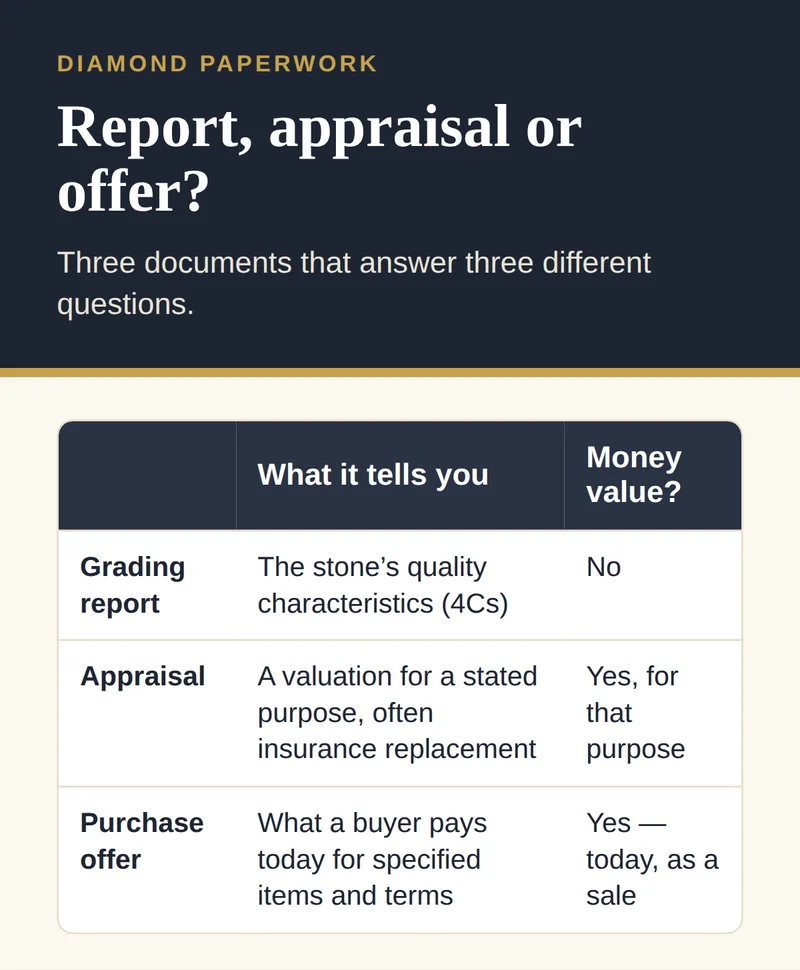
The purpose also sets the value basis. An insurance appraisal usually states a retail replacement value, meaning the cost of replacing the item new, while an estate or fair-market-value appraisal uses a different basis. Neither is a purchase offer, which is why an insurance figure is often well above what a buyer will pay.
Ask about the person's relevant qualifications
GIA's appraisal guidance distinguishes gemological knowledge from appraisal training. Ask the individual to explain both their stone-identification background and the valuation qualifications relevant to the assignment.
Request the exact credential and issuing organization so you can verify the claim. Ask about experience with your type of jewelry, such as an antique mounting, a colored diamond or a large collection. An impressive general title is less useful than an answer about the actual work.
GIA states that its reports and educational awards are not GIA certification of a business or gemstone. A reference to GIA education should identify the credential accurately rather than suggest GIA endorsement of the appraisal.
Agree on the report and examination
Ask for a description or sample of the report format. Confirm which items will be examined, which documents you should bring and how each item will be identified in the resulting report. For a collection, agree whether values will be itemized.
- What is the stated purpose and valuation date?
- Which item descriptions and photographs will be supplied?
- Will stone weights or grades be measured, taken from records or estimated?
- What examination limits will be disclosed?
- Does further laboratory work require a separate agreement?
Keep assumptions visible. A mounted stone may prevent some observations, and a prior report must be matched to the actual diamond. Ask how any uncertainty affects the assignment.
Confirm fees, timing and buying interests
Request the fee basis, expected delivery and any additional charges before work begins. Describe the number and complexity of the pieces so the appraiser can answer for your actual collection. A general article cannot supply a reliable quote for every assignment.
Ask whether the appraiser also proposes to buy the item or has another interest in the transaction. If you need an independent valuation, explain that requirement explicitly. Keep any separate purchase proposal clearly labeled.
Use grading reports for their stated information
GIA's sample diamond reports show stone-quality information. They do not replace a monetary appraisal or guarantee what a buyer will pay. Bring existing records without treating their different figures and descriptions as interchangeable.
If your purpose is selling a natural diamond
Cash 4 Gold & Diamonds buys natural polished diamonds of any size and shape. We do not buy laboratory-grown, uncut or rough diamonds. Our diamond-buying service concerns evaluating an item for purchase.
Call 310-663-1340 or arrange a visit to 617 S. Hill Street, Los Angeles, CA 90014. Explain any separate formal-report requirement before assuming a purchase evaluation meets it.
Questions about choosing a diamond appraiser
Must I buy an appraisal before requesting an offer?
Not automatically. Explain your purpose and documents first, then decide whether a separate valuation would help with the decision you need to make.
Does a GIA credential mean GIA has endorsed the appraiser's valuation?
No. A GIA diploma or other educational credential shows training the individual completed, and GIA states that its reports and educational credentials are not GIA certification of a business or gemstone. Ask for the exact credential name and issuing organization so you can verify it, and ask separately about the person's valuation training for your assignment.
Can a GIA grading report stand in for a diamond appraisal?
No. A GIA grading report describes the examined diamond's quality characteristics, such as weight, color and clarity, but it does not assign a monetary value. An appraisal states a value for a stated purpose and date. Our guide to checking a GIA report before selling explains how to match the document to your stone.
Can an appraiser who also offers to buy my diamond give an independent valuation?
Ask before any work begins. The appraiser should disclose whether they propose to buy the item or have another interest in the transaction. If you need an independent valuation, state that requirement explicitly, and keep any purchase proposal clearly labeled and separate from the appraisal report.
Is a purchase evaluation the same as a diamond insurance appraisal?
No. A purchase evaluation considers a diamond for a proposed purchase, while an insurance appraisal is a formal valuation prepared for an insurer's requirements and stated valuation date. Because they serve different purposes, a buyer's offer should not be treated as a report your insurer will accept. Ask the recipient what it requires before commissioning separate work.
What should I ask when choosing a diamond appraiser in Los Angeles?
Ask about the intended use, valuation date, report format, fees, timing and examination limits, along with the person's relevant qualifications. Request the exact credential and issuing organization so you can verify it, and ask about experience with your type of jewelry. Also ask whether the appraiser proposes to buy the item or has another interest in the transaction.