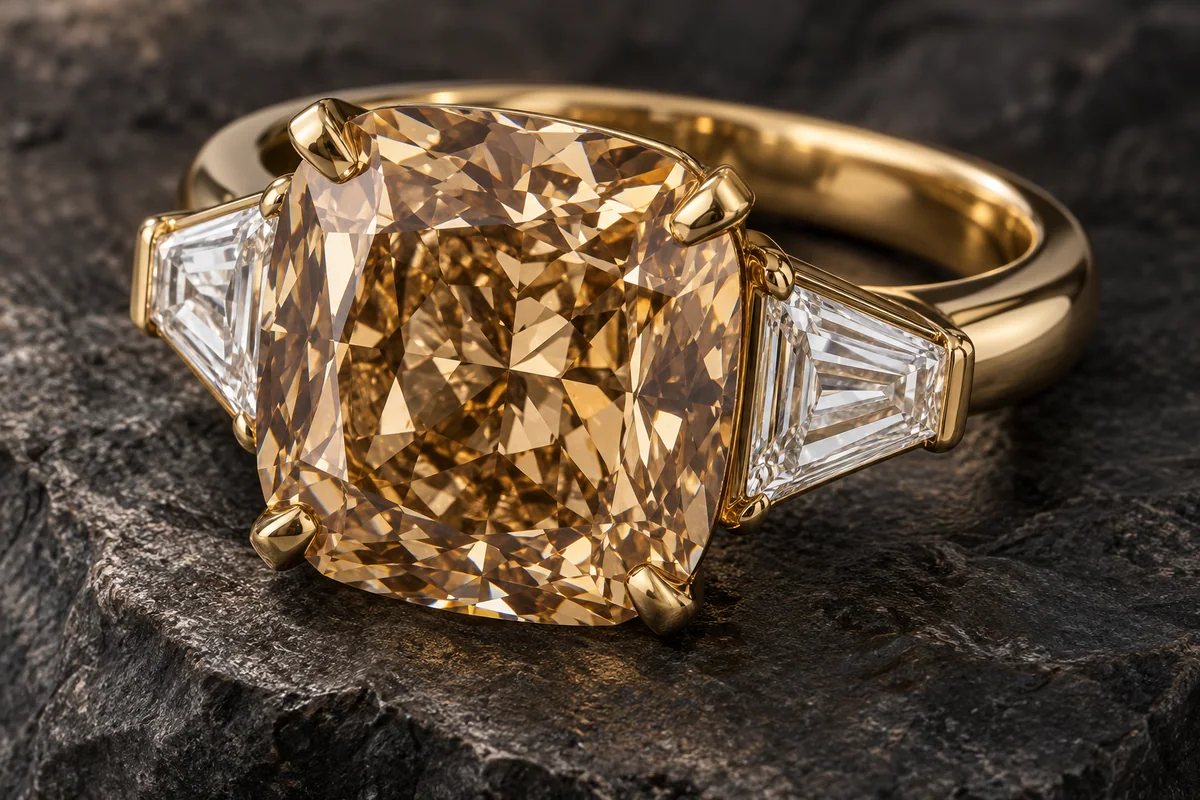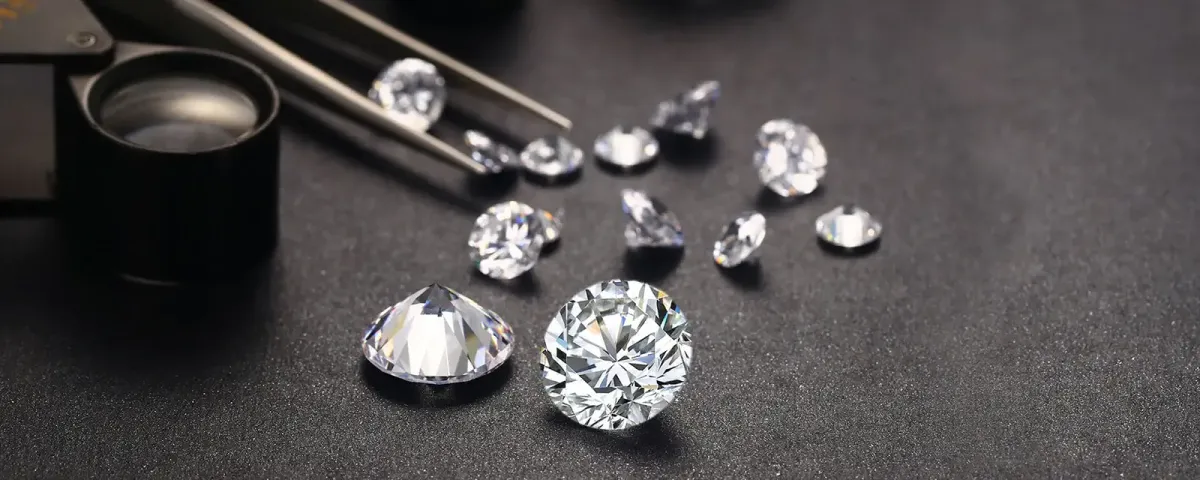
Champagne diamonds have become increasingly popular in the jewelry market over the last decade. These warm-toned stones offer a distinctive alternative to traditional white diamonds, and they’re often marketed as rare, exclusive, and unique. But what are they really? And more importantly, if you own one, where do you sell it for the best price?
Here’s the honest truth: champagne diamonds are technically lower color grades on the diamond grading scale. They fall into the K-Z range, meaning they contain visible brown undertones. Retailers market them as premium alternatives, positioning the warm golden hue as a desirable aesthetic choice rather than a color deficiency. It’s clever branding, and it works. But if you’re considering buying, selling, or evaluating a champagne diamond, you need to understand what you’re actually dealing with.
Related: Diamond Gems in Los Angeles: Your Complete Buying & Selling Guide
This guide breaks down champagne diamonds, compares your buying and selling options, and shows you how to get a fair evaluation. If you’re in Los Angeles and ready to sell, Cash 4 Gold & Diamonds offers transparent appraisals and immediate payment for diamonds of all grades.
What Exactly Is a Champagne Diamond?
A champagne diamond is a diamond with brown undertones that sit in the lower color grades (K through Z on the GIA color scale). The term “champagne” is pure marketing. It rebrands what would traditionally be considered a color deficiency into a warm, romantic aesthetic.
These stones catch light differently than colorless or near-colorless diamonds (D-J grades). The golden, peachy, or brownish warmth creates a softer, more unique appearance. Some people find this genuinely beautiful. Others see it as a lower-quality stone sold at premium prices.
The champagne label emerged as a marketing strategy to expand the diamond market beyond the “colorless is best” narrative. It’s worked remarkably well. Consumers who appreciate warmth and uniqueness now view champagne diamonds as a deliberate choice, not a compromise.
Champagne Diamonds vs. White Diamonds: Key Differences
| Feature | Champagne Diamond | White Diamond |
|---|---|---|
| Color Grade | K-Z (lower grades) | D-J (higher grades) |
| Undertone | Brown, golden, peachy | Colorless to near-colorless |
| Price Per Carat | Lower | Higher |
| Market Perception | Trendy, distinctive | Classic, traditional |
| Resale Value | Moderate, trend-dependent | Higher, more stable |
Where to Buy Champagne Diamonds: Comparing Your Options
1. Online Retailers (Brilliant Earth, James Allen, Blue Nile)
Pros: Convenient browsing, competitive pricing, extensive inventory, detailed stone information, easy comparisons.
Cons: You can’t see the diamond in person before purchasing. Return policies vary. Shipping can take days or weeks. No immediate evaluation of existing stones.
Best for: Buyers who know what they want and trust online specifications. First-time diamond shoppers who want competitive pricing.
2. Major Jewelry Retailers (Zales, Kay, Helzberg)
Pros: Physical storefronts where you can see diamonds in person. Professional staff (usually). Wide selection. Financing options available.
Cons: Markups are typically 100-200% above wholesale cost. Limited expertise on champagne diamonds specifically. Hard-sell environment. Resale buyback programs often offer poor value.
Best for: Buyers who want to view stones in person and don’t mind paying retail prices for convenience.
3. Independent Jewelers
Pros: Personalized service. Often lower markups than major chains. Can source specific stones. Real expertise. Build relationships for future sales or appraisals.
Cons: Quality varies widely. Harder to research reputation. Limited inventory. May not specialize in champagne diamonds specifically.
Best for: Buyers who have found a trusted jeweler and want customized service.
4. Auction Houses (Christie’s, Sotheby’s)
Pros: Authenticated, rare stones. Detailed documentation. Can reach international buyers. High-profile sales for investment-grade diamonds.
Cons: Auction house fees (20-25%). High buyer’s premium. Only relevant for exceptional stones. Months-long sales process.
Best for: Collectors selling rare, high-value champagne diamonds with documented provenance.
5. Cash 4 Gold & Diamonds (Los Angeles)
Pros: Expert evaluation by professionals with 19+ years of experience. Transparent pricing based on current market rates. Same-day cash payment. No pressure, no haggling. Walk-in appraisals free. You see and hear the evaluation in real time. Fair market offers. Trusted by the Los Angeles community. Whether you’re selling or buying, you get honest answers about color grade, clarity, and realistic value.
Cons: Los Angeles location only (though you can mail diamonds for remote evaluation). Selling only (not a retail buyer).
Best for: Anyone in Los Angeles selling a champagne diamond and wanting fair market value, transparency, and immediate payment. Estate settlements, inherited diamonds, or anyone downsizing a collection.
Our Pick: If you own a champagne diamond and need to sell it, Cash 4 Gold & Diamonds is your best option in Los Angeles. You get professional evaluation, no pressure, and cash the same day. The team understands that champagne diamonds are lower color grades and prices them accordingly. No inflated offers followed by haggling. No hidden fees. Just honest value.
How Champagne Diamonds Are Priced
Champagne diamond pricing depends on the same factors as any other diamond: carat weight, clarity, cut, and color grade.
Carat weight: Heavier stones cost exponentially more per carat. A 1-carat champagne diamond costs less per carat than a 2-carat stone of similar quality.
Clarity: Fewer visible inclusions mean higher prices. VS1 (very slightly included) clarity commands a premium over SI1 or SI2.
Cut: A well-cut stone reflects light more effectively. Poor cuts reduce value significantly.
Color grade: This is where champagne diamonds differ. K-Z grades cost 30-50% less per carat than D-J grades, even if all other factors are equal. The lower price reflects the lower market demand for colored diamonds compared to colorless ones.
A typical champagne diamond might sell retail for $2,000-$5,000 per carat, depending on clarity and cut. Resale value is typically 40-60% of what was paid, sometimes higher if the stone is particularly beautiful or has investment-grade documentation.
Is Buying a Champagne Diamond a Good Investment?
Champagne diamonds are a trendy choice, but they’re not a reliable investment like colorless or near-colorless diamonds. Here’s why:
Trend dependency: The popularity of champagne diamonds has grown, but trends change. If warm-toned diamonds fall out of fashion, resale value suffers.
Lower base value: They’re inherently lower color grades, so the market ceiling is lower. You’ll never get the price-per-carat return on a champagne diamond that you would on a D or E color stone.
Buyer preferences: Most diamond buyers still prefer colorless or near-colorless stones. This limits your potential buyer pool when you resell.
Better alternative: If investment is your goal, buy the best quality diamond you can afford (high clarity, excellent cut, D-H color). You’ll have more buyers and better resale potential.
Buy champagne diamonds because you love the warm aesthetic, not because you expect to make money. Treat them as a beautiful piece you enjoy wearing, and if resale value holds or appreciates, consider it a bonus.
Selling Your Champagne Diamond: What to Expect
If you inherited a champagne diamond, received one as a gift, or are upgrading your collection, here’s what to expect when you sell:
Get it certified: A GIA or AGS certificate increases buyer confidence and justifies your asking price. Without certification, buyers assume the worst and offer less.
Know your baseline: Look up similar stones online to understand market pricing. Blue Nile and James Allen list hundreds of champagne diamonds with prices. This gives you realistic expectations.
Understand the markdown: Retail markup is typically 100-200%. If you paid $3,000 for a stone at a jewelry store, expect to sell it for $1,200-$1,800. This is normal. Jewelry doesn’t hold value like precious metals.
Choose your channel: Online consignment, local buyers, or auction houses each have pros and cons. For fast, fair offers with no hassle, a trusted local buyer like Cash 4 Gold & Diamonds in Los Angeles offers same-day payment and transparent evaluation.
Get multiple appraisals: Never accept the first offer. Get at least two independent evaluations before selling. This protects you from unfair low-ball offers and gives you confidence in the final price.
How to Evaluate a Champagne Diamond Before Buying
If you’re shopping for a champagne diamond, here’s what to check:
Related: White Diamond: What You Need to Know Before Buying
Related: 10K Diamond Ring: What You Need to Know Before Buying
1. Color consistency: Look at the stone under different lighting. Is the brown/golden tone uniform throughout, or are there patches of lighter or darker areas? Uniform color is more desirable.
2. Clarity: Ask for a GIA report. Aim for VS2 or better. Even at discount prices, champagne diamonds should have good clarity.
3. Cut quality: A well-cut champagne diamond will sparkle and reflect light beautifully. A poor cut will look dull. Ask the retailer for the cut grade.
4. Certification: Always buy certified. GIA and AGS are the gold standard. This protects you when you eventually resell.
5. Price per carat: Compare prices across multiple retailers. If one retailer is significantly more expensive than others for the same specs, walk away.
Common Questions About Champagne Diamonds
Are champagne diamonds real diamonds?
Yes, absolutely. Champagne diamonds are 100% real diamonds. They’re just graded lower on the color scale because they contain visible brown undertones. The GIA treats them exactly like any other diamond for grading and certification purposes.
Why are champagne diamonds cheaper than white diamonds?
Because color is one of the four Cs (carat, cut, clarity, color). Colorless or near-colorless diamonds command higher prices due to greater market demand. Champagne diamonds are lower color grades, so they cost less. It’s basic supply and demand. The “champagne” branding adds prestige, but the economics are simple: lower color grade equals lower price.
Will a champagne diamond look bad next to a white diamond?
Not necessarily. It depends on the setting and your personal preference. A champagne diamond in a rose gold setting can look absolutely stunning. Next to a white diamond in a white gold setting, it will look noticeably warmer. If you love the warm tone, you’ll find it beautiful. If you prefer the classic white diamond look, you won’t. There’s no objective “right” answer.
How much should I expect to get if I sell my champagne diamond?
This depends on carat weight, clarity, cut, and certification. A rough rule of thumb: you’ll typically receive 40-60% of what you originally paid, sometimes more if you’re selling to a collector or dealer who specializes in champagne diamonds. Get multiple appraisals to establish fair market value. Cash 4 Gold & Diamonds in Los Angeles provides free appraisals with transparent pricing based on current market rates.